

Here is a scenario that plays out repeatedly in higher education marketing. A prospective student sees your Instagram ad, clicks through to a beautifully designed landing page, and fills out an enquiry form. They receive a confirmation email. They then visit your main website and find an entirely different visual style, different messaging, and a programme page that doesn’t reference any of the content that caught their attention in the first place. A week later, they receive a bulk email newsletter with no mention of what they enquired about.
That prospective student’s experience of the institution is fragmented, inconsistent, and disappointing — before they’ve ever set foot on campus or spoken to a single person. And research suggests this is not an edge case; it is the norm. Most higher education institutions have not yet built the systems, strategy, or cultural alignment required to deliver a coherent omnichannel experience to every prospective student.
This post explains what omnichannel marketing actually means in a higher education context, why it matters, and how to build it.
What Omnichannel Marketing Actually Means

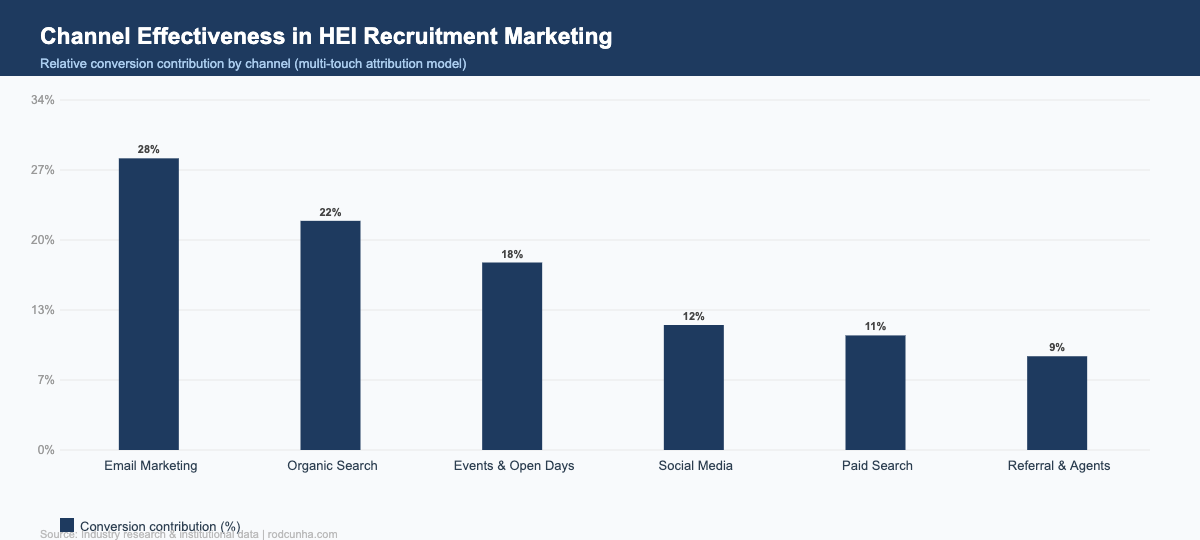
Omnichannel marketing is frequently confused with multichannel marketing, so let’s be precise. Multichannel means being present on multiple channels — having a website, social media accounts, an email list, and paid advertising campaigns. Most universities are multichannel. Omnichannel means that all of these channels work together as a coherent, integrated system — with consistent messaging, shared data, and a student experience that flows seamlessly from one channel to the next.
The distinction matters enormously. A multichannel approach treats each channel as a separate campaign. An omnichannel approach treats every channel as a touchpoint in a single, continuous relationship with a prospective student. The difference in the student experience is profound — and so is the difference in results.
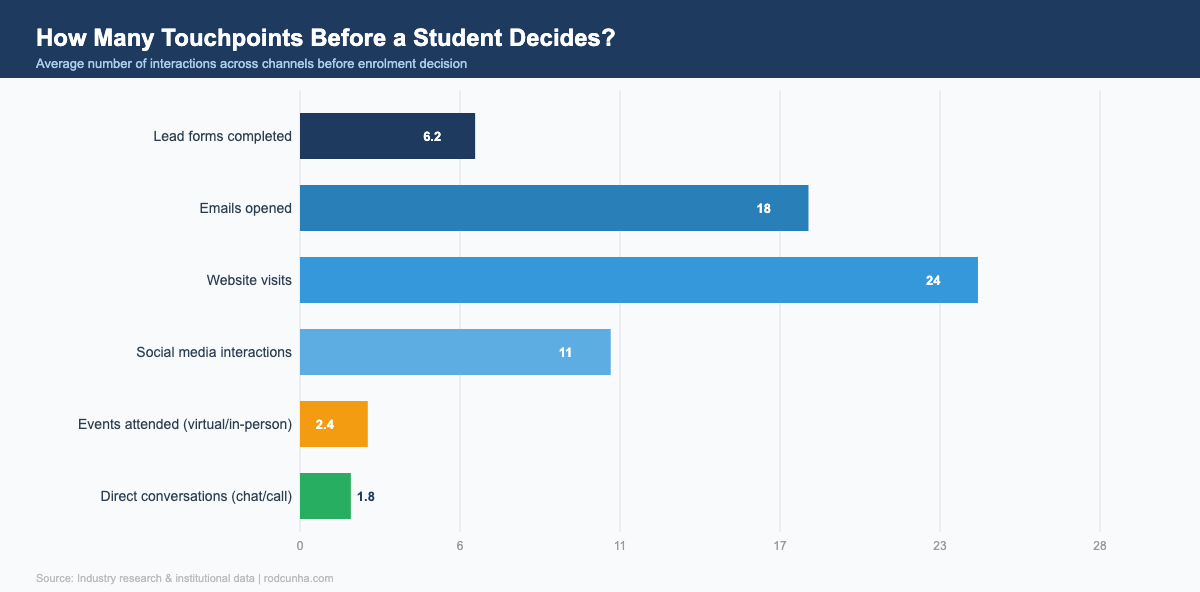
Research shows that prospective students fill out an average of six or more lead forms before making an enrolment decision. These touchpoints span multiple channels over months. The institution that manages this journey coherently — where every interaction builds on the previous one — creates a dramatically more compelling and trustworthy experience than one where each interaction resets to zero.
The State of Omnichannel in European Higher Education
On average, 75% of marketing and communications staff at higher education institutions don’t report centrally — they report to their college dean or department head. The result is multiple, competing brand voices, disconnected technology stacks, and an absence of the data integration required for true omnichannel delivery.
This structural reality is the root cause of most omnichannel failures in higher education. It’s not primarily a technology problem — it’s a governance, alignment, and data problem. The technology to deliver a coherent omnichannel experience exists. The organisational conditions to deploy it effectively are rarer.
Building Blocks of an Omnichannel Strategy
1. A Unified Student Data Foundation
Omnichannel marketing is impossible without a single source of truth for student data. Every interaction a prospective student has with your institution — a website visit, a form fill, an event registration, an email open, a chatbot conversation, a social media click — needs to be captured in a unified profile that all teams can access and act on.
This is where CRM becomes essential. As we explore in How to Use Salesforce to Build a Student Recruitment Marketing Engine, platforms like Salesforce Education Cloud create the unified data architecture that makes omnichannel possible. Without this foundation, every channel operates in isolation — knowing only what happened on that channel, blind to everything that happened elsewhere.
2. Consistent Brand Identity Across Every Touchpoint
Consistency is the hallmark of an omnichannel experience. The visual identity, tone of voice, and core messaging your institution uses on Instagram should be recognisably the same as what appears in your email communications, on your website, in your paid search ads, and in the materials handed out at an open day.
This sounds elementary, but the departmental fragmentation described above makes it genuinely difficult to achieve. A faculty of engineering with its own marketing team and its own visual identity creates friction in the student experience — even if both the faculty and the central marketing team are doing good work independently.
Investment in a strong central brand framework — with clear guidelines, flexible templates, and governance processes — is a prerequisite for omnichannel consistency. This doesn’t mean every department looks identical; it means every department looks like it belongs to the same institution.
3. Channel-Appropriate Content That Tells a Coherent Story
Content that works on TikTok will not work in an email, and content that works in a printed prospectus will not work on Instagram. Omnichannel marketing doesn’t mean identical content across all channels — it means content that is appropriately formatted for each channel while serving a coherent narrative arc.
The University of East Anglia provides a useful example: their TikTok account, with over 75,000 followers, creates content that is native to the platform — short, informal, and visually engaging — while using a Linktree in the bio to seamlessly connect social media visitors to a structured journey through admissions, virtual tours, and application information on their main site. The content is channel-appropriate; the journey is coherent.
Research confirms that 83% of prospective students watch YouTube an average of three or more times per day. YouTube is therefore not just a social platform — it’s a search and discovery channel that should be integrated into your overall content and SEO strategy, with programme explainer videos, faculty talks, and student testimonials that are optimised for both search and sharing.
4. Behavioural Triggers That Connect the Dots
True omnichannel marketing uses behavioural data to ensure the experience adapts to what the student actually does — not just to the stage of a predetermined journey they’re supposed to be at.
If a prospective student watches three video testimonials from engineering students on your website but hasn’t yet enquired, a retargeting ad showing more engineering-specific content is a better response than a generic institutional ad. If they attended a postgraduate open day but haven’t started an application two weeks later, a direct email from a postgraduate admissions advisor — not an automated newsletter — is the appropriate intervention.
These behavioural triggers are enabled by data integration and marketing automation. They require both the technology infrastructure (CRM, marketing automation, analytics integration) and the strategic thinking to map the right response to the right signal.
5. A Joined-Up Measurement Framework
You cannot manage an omnichannel strategy if you’re measuring each channel in isolation. Multi-touch attribution — the ability to see which combination of channels and touchpoints contributed to an enrolment — is the measurement ambition that makes omnichannel optimisation possible.
In practice, full multi-touch attribution is complex to implement, particularly in a higher education context where the decision journey spans many months and many channels. But even partial integration — connecting email engagement data with web analytics data and application system data — provides significantly better insight than siloed channel reporting.
Common Omnichannel Mistakes
Treating offline and online as separate. An open day visit is a touchpoint in the digital journey, not a separate track. Students who attend an open day should be identified in your CRM, and their subsequent digital experience should reflect their attendance. Failure to connect these worlds creates jarring discontinuities.
Ignoring the post-enrolment journey. The student experience doesn’t end at enrolment, and neither should the integrated approach. Students who feel well-supported throughout their studies become the alumni advocates and positive reviewers who fuel future recruitment. An omnichannel mindset extends through the student lifecycle — not just the recruitment funnel.
Underinvesting in data governance. Unified student profiles only work if the data feeding them is clean, accurate, and maintained. Duplicate records, outdated contact information, and inconsistent data entry across teams will undermine even the most sophisticated omnichannel strategy.
Where to Start
If you’re beginning your omnichannel journey, prioritise ruthlessly. Start with the two or three channels where you have the highest engagement and the most to gain from integration. Map the current student experience across those channels — and identify the specific disconnects that are creating friction. Fix those disconnects first, then build outward.
The goal is not perfection from day one. It’s a continuous improvement process — adding channels, improving data integration, and refining the student experience over time. The institutions making the most progress are those that started this journey early and have been iterating on it consistently, not those waiting until all the pieces are perfectly in place.
For the email dimension of your omnichannel strategy, see How to Build a University Email Marketing Strategy That Moves Prospects From Open Day to Offer. For the international student dimensions, see International Student Recruitment in Europe: How to Market Your University After the Visa Crisis.
Sources & Further Reading
- Terminalfour: How to Create an Omnichannel Digital Marketing Experience for Students
- Plumlogix: Higher Education Student Omnichannel Experience
- GeckoEngage: Omni-Channel Marketing and Why It Matters in Higher Education
- Liaison: Benefits of Omnichannel Marketing in Higher Education
- Salesforce: CRM in Higher Education — A Complete Guide