
Something significant has shifted in how prospective students find universities. It’s not a slow evolution — it’s a rapid structural change, and many higher education marketing teams haven’t fully reckoned with what it means for their work.
The change is this: AI-powered search tools — Google’s AI Overviews, ChatGPT, Perplexity, Microsoft Copilot, and others — are becoming the first stop for students researching their options. Instead of browsing a list of search results, students are asking conversational questions and receiving synthesised, confident answers. Your institution either appears in those answers or it doesn’t. And if it doesn’t, you might as well not exist for that student in that moment.
This post explains what’s happening, why it matters, and — most importantly — what HEI marketers can do about it.
From Search Engine to Answer Engine: The Shift That Changes Everything

For the past two decades, search engine optimisation (SEO) in higher education has meant roughly the same thing: rank highly on Google for keywords that prospective students use. Get on page one. Get clicked.
That model is not dead, but it is being disrupted at pace. Bain & Company’s research found that approximately 80% of consumers now rely on “zero-click” results in at least 40% of their searches, with organic web traffic declining by an estimated 15–25% as a result. Roughly 60% of searches now end without the user navigating to an organisation’s website at all.
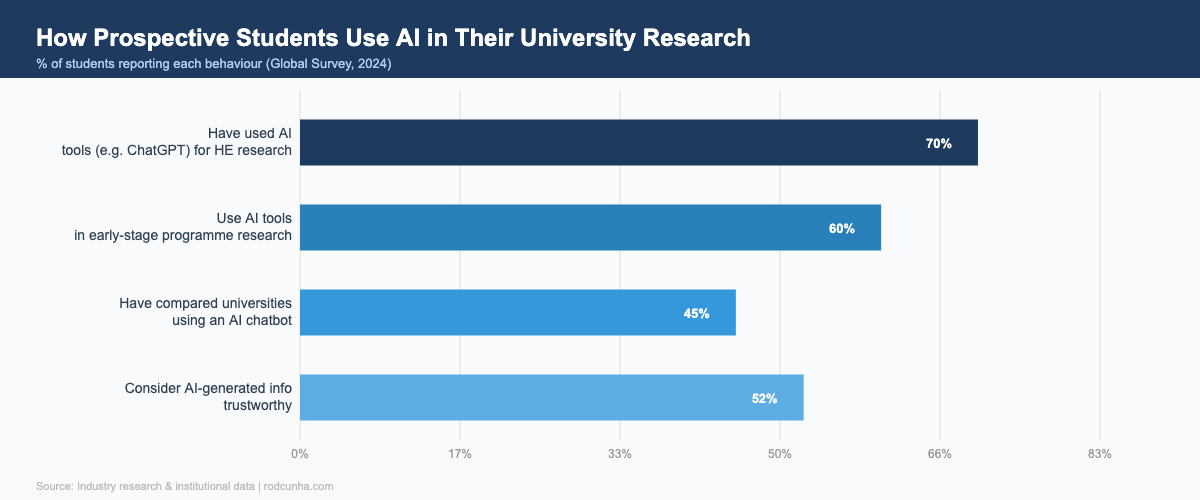
In parallel, prospective students are increasingly turning to generative AI tools as their first research step. A 2024 global survey found that approximately 70% of prospective students have used AI tools like ChatGPT to search for information, with more than 60% reporting they use these tools during the early phases of their university research.
The implication is significant: website traffic may be declining even while your marketing spend stays the same — and the reason is that a growing proportion of your potential audience is finding answers (from AI) before they ever reach your site.
What Is Generative Engine Optimisation (GEO)?
Generative Engine Optimisation — or GEO — is the emerging discipline of ensuring your institution is represented accurately and prominently in AI-generated responses. It builds on traditional SEO but extends into new territory.
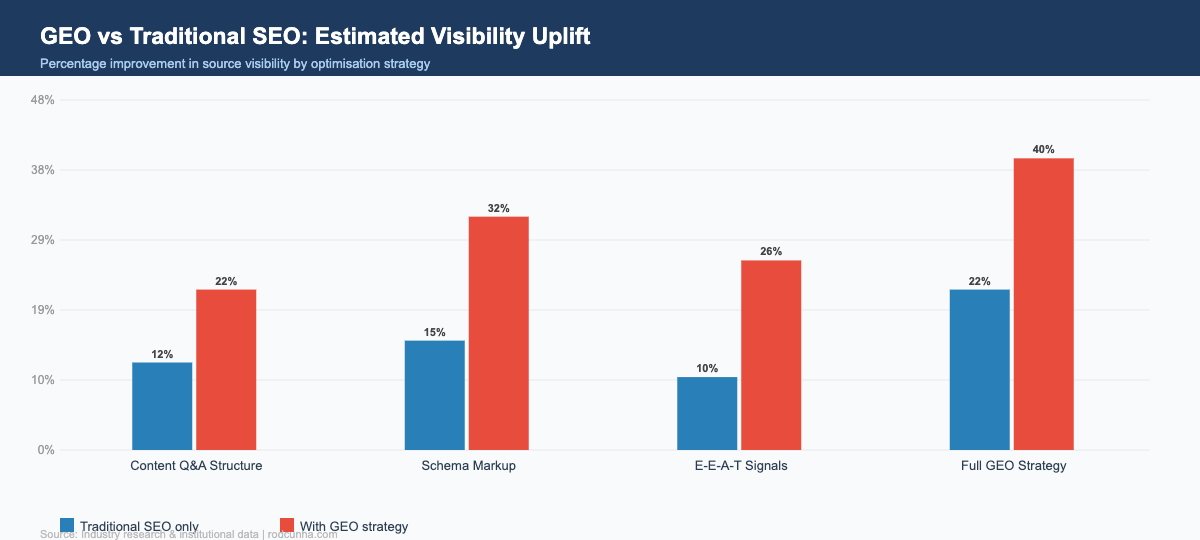
Where SEO aimed to put your webpage at the top of a results list, GEO aims to make your institution part of the answer itself — quoted, cited, or named by the AI when a student asks a relevant question. Research suggests that proper GEO implementation can boost source visibility in generative engine responses by up to 40%.
The distinction is important. An AI system doesn’t return a ranked list of links — it synthesises information and presents a conclusion. If your institution’s content isn’t feeding that synthesis, you’re absent from the conversation entirely.
How AI Systems Decide What to Surface
To optimise for AI search, it helps to understand how these systems work. Large language models like GPT-4 and Google Gemini are trained on vast datasets of publicly available text. They learn to associate certain sources with credibility, accuracy, and relevance. When a user asks a question, the model draws on this training to construct an answer — and it tends to draw on sources that meet several criteria:
- Expertise and authority: Content written by credible, named experts, affiliated with recognised institutions.
- Factual accuracy and recency: Information that is verifiable, up to date, and consistent across multiple sources.
- Structural clarity: Content that is well-organised, uses headings, answers specific questions directly, and employs schema markup.
- Broad citation: Content that is referenced by other credible sources — media coverage, academic citations, external links.
Universities have natural advantages here: faculty expertise, institutional credibility, published research. But many fail to translate these advantages into content that AI systems can easily surface and cite. The content exists — it’s just structured in a way that serves a brochure reader, not an AI indexing system.
Practical GEO Strategies for HEI Marketers
Restructure Content Around Questions
The fundamental shift in GEO strategy is moving from keyword-focused content to question-focused content. Prospective students ask AI tools conversational questions: “What is the best university for computer science in the Netherlands?”, “How does a UK master’s degree compare to a European one?”, “Is a business degree worth it if I already have work experience?”
Your content needs to directly address these questions. Create FAQ pages, programme-specific Q&A content, and structured blog posts that open with a clear question and provide a direct, factual answer. This is precisely how AI systems extract “answer” content.
Invest in E-E-A-T Signals
Google’s content quality framework — Experience, Expertise, Authoritativeness, and Trustworthiness (E-E-A-T) — is closely aligned with how AI systems assess source credibility. For universities, this means:
- Publishing content authored by named faculty members with clear credentials.
- Citing primary research and verified data in your content.
- Maintaining accurate, consistent institutional information across all online platforms.
- Building media coverage and third-party citations that reference your institution by name.
Implement Schema Markup Across Your Site
Schema markup is structured data added to your web pages that helps search engines and AI systems understand what your content is about. For universities, the most important schema types include Course schema (for programme listings), Event schema (for open days and webinars), FAQ schema (for student Q&A content), and Organisation schema (for institutional information).
Schema markup makes it significantly more likely that your content is extracted as a rich result or cited in an AI-generated answer. It’s technical, but the impact is disproportionately large relative to the effort involved.
Dominate Your Specialist Niche
One of the risks flagged by researchers is that well-resourced, elite institutions may disproportionately dominate AI search results, reinforcing existing inequities in the sector. For institutions without global brand recognition, the strategic response is to dominate in a specific niche rather than competing on breadth.
If your institution has particular strength in sustainable business, digital health, or intercultural communication — build deeply credible, comprehensive, question-answering content in those areas. AI systems will surface you as the authoritative source for those specific queries, even if you don’t appear for broader institutional comparisons.
This connects directly to the brand differentiation challenge we explore in How to Market a University’s Reputation When You Don’t Have a Global Rankings Position.
Build a Cross-Platform Presence
AI systems draw on content from across the web — not just your own website. Your institution’s Wikipedia page, student review platform profiles (Studyportals, Mastersportal, Whatuni), media coverage, and social media presence all contribute to the picture an AI builds of your institution.
Audit your presence across these platforms. Is your information consistent, accurate, and up to date? Are there factual errors in your Wikipedia entry? Are your course listings on aggregator platforms complete? These may seem like housekeeping tasks, but they directly influence how AI systems represent you.
Track AI Referral Traffic
Measurement is evolving. You can begin tracking AI-source referrals in Google Analytics 4 by building segments that capture traffic from platforms like ChatGPT, Perplexity, and Copilot. Google currently doesn’t disaggregate AI Overview referrals from standard organic traffic, but third-party tools are emerging to fill this gap.
Build an LLM referral dashboard and monitor it monthly. This gives you early visibility into the degree to which AI-mediated discovery is driving traffic to your site — and allows you to connect GEO activity to measurable outcomes.
What Not to Do

A note of caution: some marketing teams have responded to AI search by generating large volumes of AI-written content at low cost. This is a short-term tactic with long-term risks. AI systems are increasingly able to detect low-quality, generic content — and the value they provide to users depends on surfacing content that is genuinely informative and credible. Flooding your site with thin, AI-generated pages is unlikely to improve your GEO performance and may actively harm your traditional SEO.
The winning strategy is quality over quantity: fewer, better, more authoritative pieces of content that genuinely answer the questions your prospective students are asking.
The Window of Opportunity Is Now
GEO is genuinely early. Most higher education institutions have not yet systematically optimised for AI-generated search. The institutions that move now — restructuring content, implementing schema markup, building authority, and monitoring performance — will establish positions in AI-generated answers that competitors will find difficult to displace.
As one specialist put it: “GEO isn’t an extra credit assignment — it’s a required course in staying visible.” For HEI marketers, the question is not whether to adapt to AI-powered search. It’s how quickly you can move.
For the foundational digital visibility strategy that underpins GEO success, see Why Your University Is Invisible Online — And What HEI Marketers Can Do to Fix It. For how this visibility strategy integrates with your CRM, see How to Use Salesforce to Build a Student Recruitment Marketing Engine That Actually Converts.